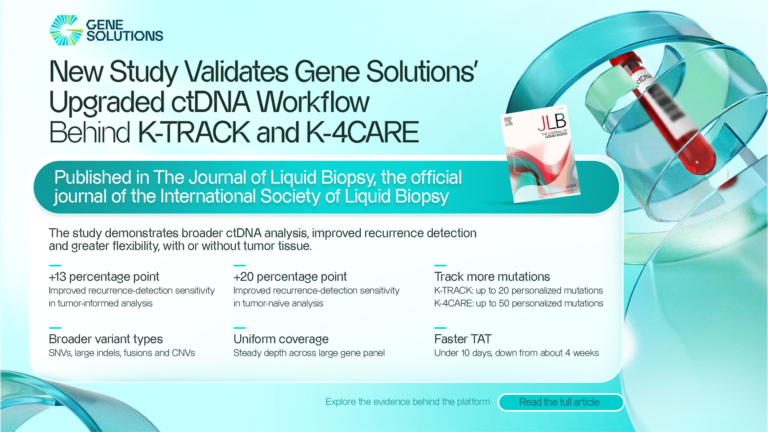
The latest data from Gene Solutions demonstrates the clinical value of personalized ctDNA monitoring with the K-TRACK™ platform
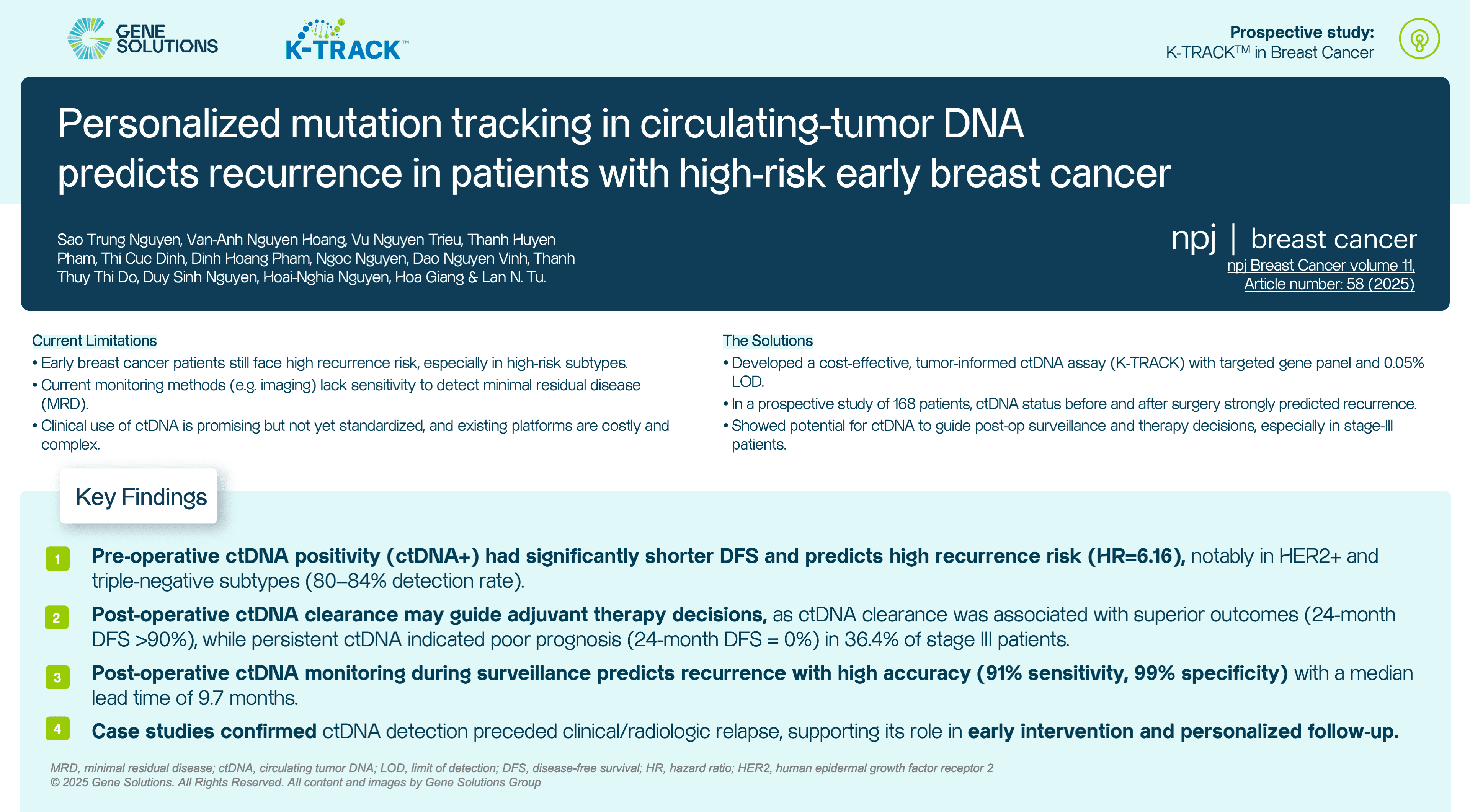
A prospective study recently published in npj Breast Cancer provides compelling data on the prognostic value of circulating tumor DNA (ctDNA) in early-stage breast cancer. Conducted by Gene Solutions in collaboration with leading Vietnamese cancer centers, the study evaluated personalized ctDNA monitoring using the K-TRACK™ platform in a cohort of 168 patients with stage I–III breast cancer.
The findings demonstrate that ctDNA detection at key clinical milestones— pre-operatively, post-operatively, and during surveillance—can identify patients at significantly higher risk of recurrence, often months before conventional imaging or symptoms emerge and may guide adjuvant therapy decisions.
- Read the full study: npj Breast Cancer – Nature Portfolio
- Download the summary: https://genesolutions.com/wp-content/uploads/2025/07/K-TRACK-Breast_Publication-Summary_npj-BC.pdf
Key Findings
1. Pre-operative ctDNA positivity (ctDNA+) had significantly shorter DFS and predicts high recurrence risk
- Patients with detectable ctDNA before surgery (ctDNA+) had a significantly lower 24-month disease-free survival (DFS) rate-5% lower than ctDNA- patients.
- Pre-operative ctDNA was more frequently detected in aggressive subtypes: ~83.8% in HER2+ and 80.0% in triple-negative breast cancer (TNBC).
- ctDNA+ status was associated with a 6-fold increased risk of recurrence, even within high-risk subgroups.
- Higher variant allele frequency (VAF ≥ 0.18%) was significantly correlated with poorer DFS.
2. Post-operative ctDNA may guide adjuvant therapy decisions
- Persistence or emergence of ctDNA (Pos → Pos or Neg → Pos) indicates ineffective treatment and high risk of recurrence, with 0% DFS. Clearance of post-operative ctDNA (Pos → Neg) was associated with superior outcome.
- Among stage III patients, 36.4% remained ctDNA-positive after completing standard therapy – most of whom later relapsed. This finding underscores a potential role for ctDNA-guided adjuvant therapy escalation in high-risk subgroups.
3. Surveillance ctDNA predicts recurrence early and accurately
Post-operative ctDNA detection, particularly during surveillance, was a strong independent predictor of recurrence, demonstrating 90.9% sensitivity and 98.8% specificity. Importantly, ctDNA positivity preceded clinical relapse by a median of 9.7 months, providing a critical window for potential intervention.
4. Scalable and Cost-Effective Precision Oncology.
K-TRACK™ relies on a targeted gene panel and bespoke multiplex PCR, offering high sensitivity without the complexity or cost of large-panel NGS. This design makes it especially relevant for healthcare systems in developing countries.
Clinical Implications
This study underscores the growing role of tumor-informed ctDNA assays in the real-world management of breast cancer. Monitoring ctDNA at strategic treatment milestones enables early detection of recurrence, assessment of residual disease, and identification of patients who may benefit from escalated adjuvant therapy. These insights represent a meaningful step toward more proactive, personalized, and data-driven post-treatment surveillance.