
Next-generation prenatal screening, powered by precision cfDNA science
From a single maternal blood draw, triSure uses next-generation sequencing and multi-omic analysis to examine maternal and placental cell-free DNA. The platform brings together four screening areas to provide broader insights into maternal and fetal health: chromosomal abnormalities, including microdeletions; dominant monogenic disorders; maternal carrier status; and biological signals associated with pregnancy complications.
Global scale. Proven quality. Trusted Partnerships.
PLATFORM TECHNOLOGY
Unlocking More from a Single Blood Draw
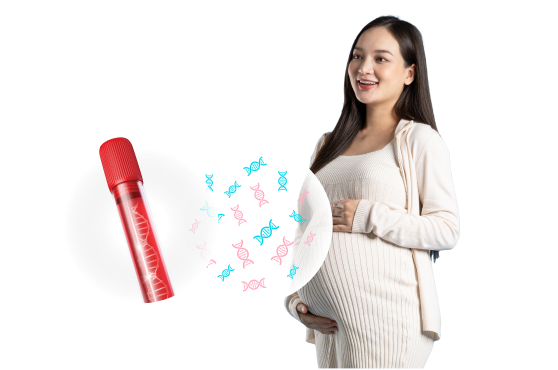
The story of triSure - Gene Solutions’ comprehensive NIPT (Non-invasive Prenatal Testing) solutions for all OBGYNs and pregnant women. A mother’s blood carries DNA fragments from both the placenta and the mother, offering a molecular window into the health of both mother and baby. While standard NIPT assesses these fragments to screen for chromosomal conditions, triSure reads much more from them, unlocking additional insights from the same blood sample and sequencing run to screen for fetal genetic abnormalities and predict maternal complications.

01
One Blood Sample
10 mL maternal blood sample from 9 weeks of pregnancy provides the foundation for triSure’s comprehensive screening and pregnancy risk prediction capabilities.
Early non-invasive testing.
Redefining first-trimester screening.

02
Deep Paired-End Sequencing
Millions of cfDNA fragments are paired-end sequenced in Gene Solutions’ CAP-accredited laboratories.
By reading both ends of each fragment, triSure reveals its genetic sequence, length, and cut-end patterns — information that standard NIPT leaves untapped.
Beyond the DNA sequence.
More insights from every fragment.

03
Multi-Omics Analysis
Genomic analysis assesses chromosome counts and gene variants.
Fragmentomic analysis examines fragment size, end motifs, and nucleosome patterns.
Together, these approaches help distinguish feta DNA signals from maternal DNA signals and support more precise screening.
Two layers of information.
One sample.

04
Multimodal Classifier, Powered by DNAsphere.AI
DNAsphere.AI combines three fragmentomic signals with genetic risk scores in a multimodal classifier to predict pregnancy risks* in the first trimester - using the same blood sample and sequencing run, with no additional blood draw or sequencing.
Turning complex data into earlier risk insights.
*Currently available for first-trimester gestational diabetes risk prediction, with preterm birth prediction under research.
PRODUCT PORTFOLIO
One blood draw, 4 screening scopes
For the FETus
01
Chromosome abnormalities in the fetus
27 chromosome conditions and 5 microdeletion syndromes
Chromosome abnormalities in the fetus
27 chromosome conditions and 5 microdeletion syndromes
COMMON TRISOMIES
- Down syndrome (T21)
- Edwards syndrome (T18)
- Patau syndrome (T13)
SEX CHROMOSOME CONDITIONS
- Klinefelter (XXY, XXXY)
- Triple X (XXX)
- Turner (XO)
- Jacobs (XYY)
RARE AUTOSOMAL TRISOMIES
- Chromosomes 1–12, 14–17, 19–20, 22
MICRODELETIONS
- Angelman
- Cri-du-Chat
- 1p36 deletion
- 22q11.2 deletion (DiGeorge)
- Prader-Willi
| Performance (1), (2), (3) | Sensitivity | Negative predictive value | Positive predictive value |
|---|---|---|---|
| Performance (1), (2), (3)Trisomy 21, 18, 13 | Sensitivity98.3% | Negative predictive value99.9% | Positive predictive value94.3% |
| Performance (1), (2), (3)22q11.2 deletion (DiGeorge) | Sensitivity>99% | Negative predictive value99.9% | Positive predictive value63.6% |
02
25 common dominant monogenic disorders
25 common dominant monogenic disorders
7,018 mutations linked to the 25 most prevalent single-gene disorders. These conditions may impact quality of life and require early intervention to prevent them from going unnoticed as the child develops.
SKELETAL DISORDER
- Achondroplasia
- Hypochondroplasia
- CATSHL syndrome
- Thanatophoric dysplasia
- Ehlers-Danlos syndrome
- Osteogenesis imperfecta
CRANIOSYNOSTOSIS SYNDROMES
- Antley-Bixler syndrome
- Apert syndrome
- Crouzon syndrome
- Jackson-Weiss syndrome
- Pfeiffer syndrome
- Muenke syndrome
NOONAN SPECTRUM DISORDERS
- Cardiofaciocutaneous syndrome
- Costello syndrome
- LEOPARD syndrome
- Noonan syndrome
SYNDROMIC DISORDERS
- Alagille syndrome
- CHARGE syndrome
- Cornelia de Lange syndrome
- Epileptic encephalopathy
- Intellectual disability
- Rett syndrome
- Sotos syndrome
- Tuberous sclerosis
- Juvenile myelomonocytic leukemia (JMML)
| Performance (4) | Sensitivity | Negative predictive value | Positive predictive value |
|---|---|---|---|
| Performance (4)25 dominant single-gene disorders | Sensitivity>99% | Negative predictive value99.9% | Positive predictive value99% |
For the mother
03
Recessive genetic disorders in parents or pregnant women
7,535 mutations related to 18 recessive diseases
Recessive genetic disorders in parents or pregnant women
7,535 mutations related to 18 recessive diseases
Screens for 18 common recessive conditions selected in accordance with ACMG guidelines. The test checks whether the mother carries genetic variants associated with serious and treatable conditions. Carriers are usually healthy. If the mother is found to be a carrier, testing the father can help determine the risk to the baby.
BLOOD DISORDERS
- Alpha-thalassemia
- Beta-thalassemia
- G6PD deficiency
- Hemophilia A
METABOLIC
- Phenylketonuria, Galactosemia
- Citrin deficiency, Wilson disease
- Pompe disease
- Ornithine transcarbamylase (OTC) deficiency
NERVOUS SYSTEM AND NEURO-METABOLIC
- Adrenoleukodystrophy
- Charcot-Marie-Tooth type 2S
- Primary carnitine deficiency
- Niemann-Pick disease
OTHER SYSTEMS
- Cystic fibrosis
- Polycystic kidney disease
- Pendred syndrome / hearing loss
- 5-alpha reductase deficiency
| Performance (5), (6) | Sensitivity | Negative predictive value |
|---|---|---|
| Performance (5), (6)18 recessive conditions | Sensitivity95-99% | Specificity>99% |
04
Pregnancy complications
Pregnancy complications
Gestational diabetes affects about 1 in 7 pregnancies, but the standard glucose test only detects it at 24–28 weeks. triSure estimates the risk in the first trimester from the same blood sample, so women at high risk can get earlier glucose testing and diet and activity advice.
| Performance (7) | Sensitivity | Sensitivity |
|---|---|---|
| Performance (7)Gestational diabetes (GDM) | Sensitivity70% | Sensitivity89% |
triSure Testing Packages
Review the screening scopes below, then discuss the package available in your country with your healthcare professional.
Package names and test scopes may vary depending on the country.
Please check with your local provider to confirm which tests are included in each package before choosing a test.
| Test scopes One blood draw, 4 screening scopes |
triSure Basic | triSure | triSure Premium | triSure Procare |
|---|---|---|---|---|
| Numerical chromosome abnormalities in the fetus | ||||
| Down - Edwards - Patau syndrome - Trisomy 21, 18, 13 | ||||
| Turner (XO) syndrome | ||||
| Triple X (XXX) syndrome | ||||
| Klinefelter (XXY) syndrome | ||||
| Klinefelter (XXXY) syndrome | ||||
| Jacobs (XYY) syndrome | ||||
| Other autosomal aneuploidies (1-12, 14-17, 19-20, 22) | ||||
| Monogenic recessive diseases from the mother | ||||
| Alpha & Beta Thalassemia - carrier screening for mother | ||||
| 16 additional recessive single-gene disorders-carrier screening for mother | ||||
| Dominant monogenic disorders | ||||
| 25 dominant single gene disorders | ||||
| Pregnancy complications | ||||
| Gestational Diabetes Mellitus (GDM) | ||||
Not sure which package to choose?
Start with pre-test counselling. Discuss the screening scopes and confirm which package is available in your country.
SCIENTIFIC EVIDENCE
Backed by science. Driven by data.
The Journal of Maternal-Fetal & Neonatal Medicine
2018
Establishing and validating noninvasive prenatal testing procedure for fetal aneuploidies in Vietnam.
NIPT for fetal aneuploidies is widely adopted in developed countries. However, limited technical expertise and skilled personnel remain major barriers to its implementation in low-income settings, despite declining sequencing costs. Here, we present triSure.
scientific reports
2022
Detection of maternal carriers of common α‑thalassemia deletions from cell‑free DNA.
α-Thalassemia is a common inherited blood disorder manifested mainly by the deletions of α-globin genes. In geographical areas with high carrier frequencies, screening of α-thalassemia carrier state is therefore of vital importance.
Personalized Medicine
2023
Developing and validating noninvasive prenatal testing for de novo autosomal dominant monogenic diseases in Vietnam.
Over 60% of single-gene (SGG) diseases in newborns are autosomal dominant variants. NIPT for monogenic conditions is cost-effective and time saving but not widely applied. This study introduces and validates NIPT-SGG in detecting 25 monogenic conditions.
RESOURCES
Resources

triSure HCP Brochure
triSure Carrier HCP Brochure
triSure HCP Flyer

triSure Patient Leaflet
NEWS & INSIGHTS
Featured News
GLOBAL OPERATIONS
Our Global Footprint
Singapore
Vietnam
Hong Kong
Philippines
India
Brazil
CAP-Accredited Laboratory
CAP-Accredited Laboratory
Indonesia
Taiwan
Malaysia
Thailand
Türkiye
USA
REFERENCES
- Phan, Minh-Duy, et al. “Establishing and validating noninvasive prenatal testing procedure for fetal aneuploidies in Vietnam.” The Journal of Maternal-Fetal & Neonatal Medicine 32.23 (2019): 4009-4015.
- Do, T., T.-T., et al. (2020). Determining the positive predictive values of NIPT triSure for detection of the most common fetal chromosome aneuploidies in clinical practice. Vietnam Medical Journal, 1(4), 172–177.
- Vinh, N., Truong, N. P., et al. (2024). Establishment and evaluation of a non-invasive prenatal screening procedure for 22q11 deletion syndrome. Vietnamese Medical Journal, 535(1B).
- Nguyen, N. Y., et al. “Developing and validating noninvasive prenatal testing for de novo autosomal dominant monogenic diseases in Vietnam.” Personalized Medicine 20.5 (2023): 425-433.
- Doan, P.-L., et al. “Detection of maternal carriers of common α-thalassemia deletions from cell-free DNA.” Scientific Reports 12.1 (2022): 13581.
- Tran, N. H., et al. “Genetic landscape of recessive diseases in the Vietnamese population from large‐scale clinical exome sequencing.” Human Mutation 42.10 (2021): 1229-1238
- Dao VN, et al. Early prediction of gestational diabetes using integrated cell-free DNA features and omics-derived genetic scores. medRxiv. 2025.