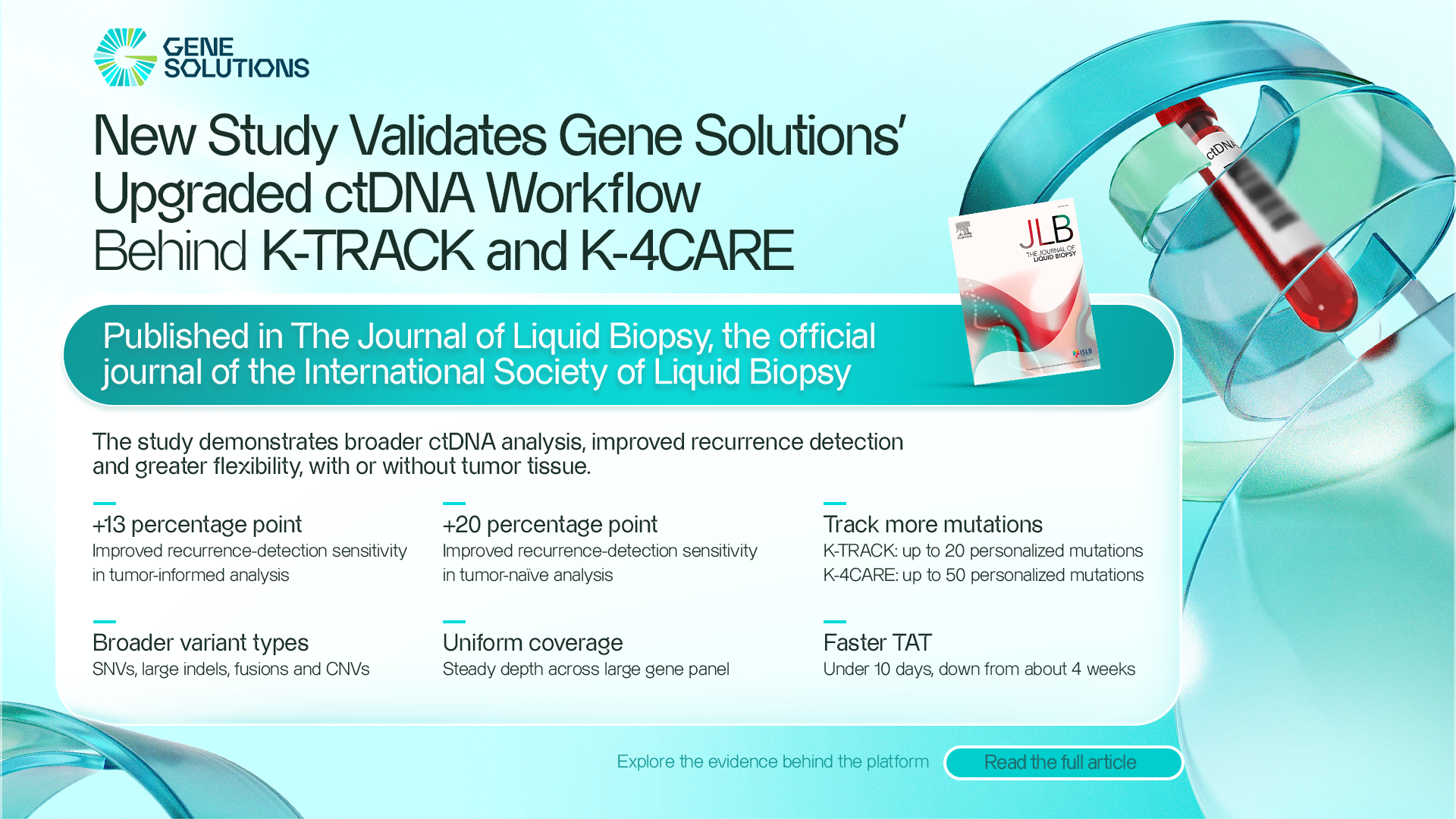
Peer-reviewed findings published in The Journal of Liquid Biopsy, an official journal of the International Society of Liquid Biopsy (ISLB), demonstrate broader ctDNA analysis, improved recurrence prediction, and greater flexibility with or without tumor tissue.
SINGAPORE, 14 October 2026 – Gene Solutions announced the publication of a new peer-reviewed study validating the upgraded ctDNA workflow behind K-TRACK, K-4CARE, and K-TRACK Blood Only.
Published in The Journal of Liquid Biopsy, an official journal of the International Society of Liquid Biopsy (ISLB), the study evaluated how Gene Solutions’ new hybrid-capture sequencing workflow and VarSURE bioinformatics pipeline improve upon its previous amplicon-based ctDNA method. The journal is published by Elsevier on behalf of the International Society of Liquid Biopsy.
Broader ctDNA detection across five cancer types
The study directly compared the new hybrid-capture method with the previous amplicon-based method using the same plasma samples, sequencing platform, and quality-control framework.
In tumor-informed analysis, where mutations from the tumor were tracked, pretreatment ctDNA detection was comparable or numerically higher across lung, colorectal, breast, gastroesophageal, and liver cancers. The clearest gain was in lung cancer when genome-wide features were added.
In tumor-naïve analysis, where tumor tissue was not used, the gain was larger. Hybrid-capture sequencing plus genome-wide signals — copy-number alterations, fragmentomics, and DNA end-motif patterns — gave numerically higher detection across all five cancers.
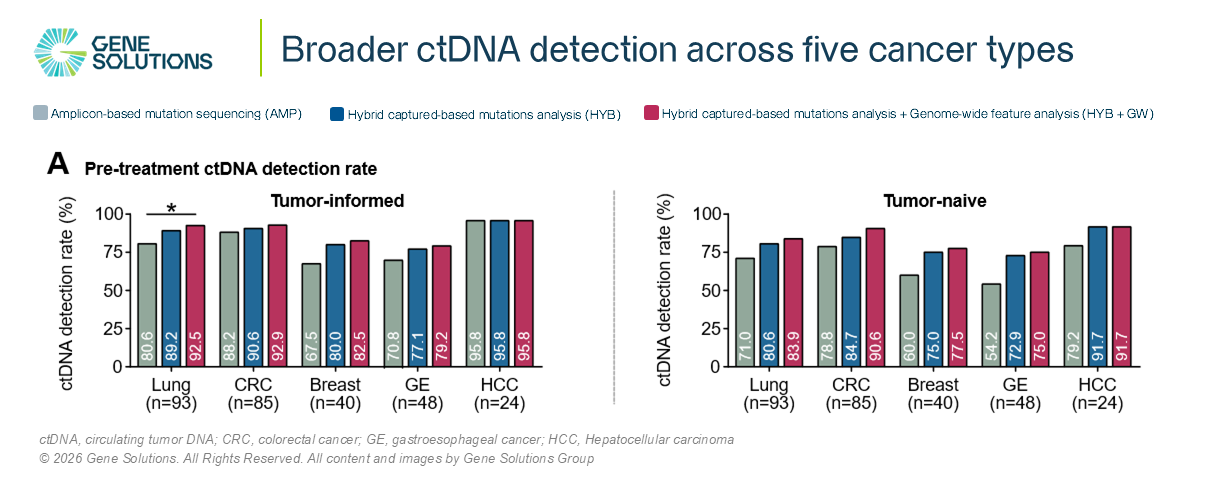
The two approaches were assessed separately. Together, the findings support use of the upgraded workflow with or without prior tumor sequencing.
Improved postoperative recurrence detection
The new method also demonstrated stronger postoperative recurrence detection in colorectal cancer (CRC), and hepatocellular carcinoma (HCC).
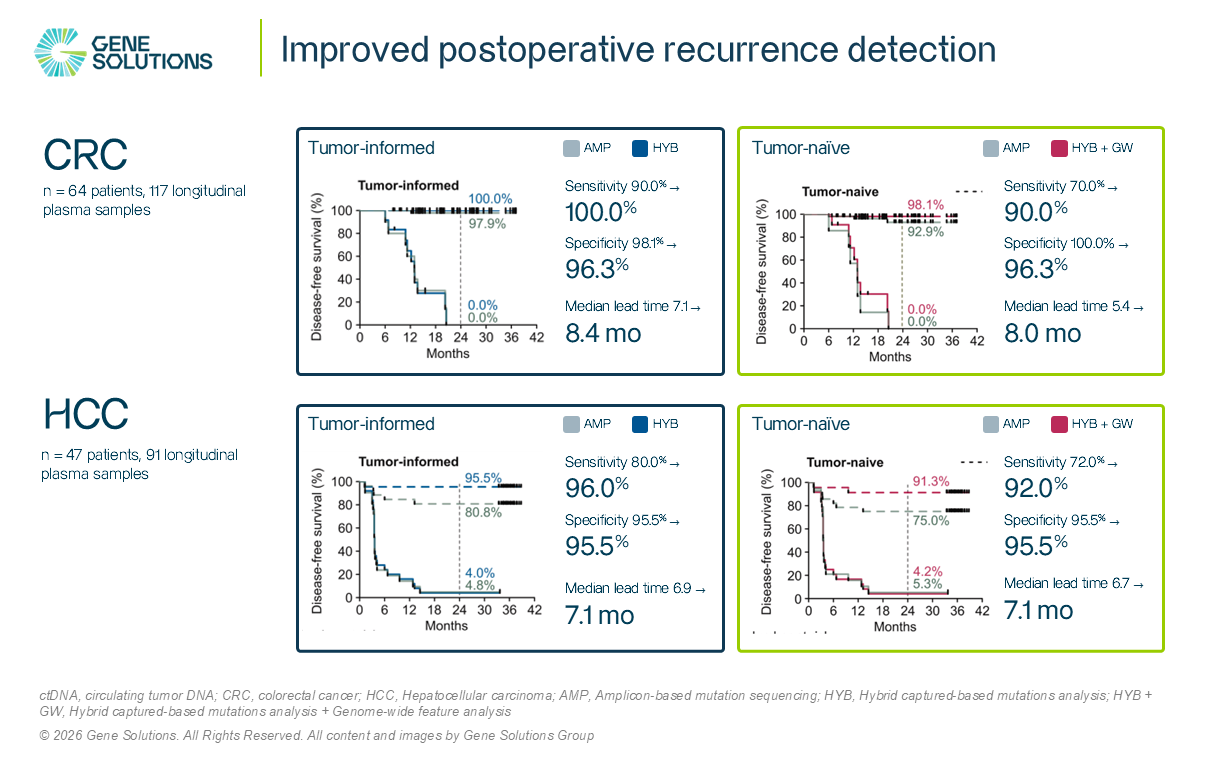
Across tumor-informed and tumor-naïve analyses, recurrence-detection sensitivity improved by an average of 16.5 percentage points compared with the previous method, with individual improvements ranging from 10 to 20 percentage points.
The improvement was observed consistently across tumor-informed and tumor-naïve assays:
- Increased tumor-informed recurrence-detection sensitivity by an average of 13 percentage points across CRC and HCC.
- Increased tumor-naïve recurrence-detection sensitivity by an average of 20 percentage points across CRC and HCC.
In CRC, the upgraded method also provided an earlier molecular indication of recurrence. Median lead time before radiological recurrence reached 8.4 months with tumor-informed monitoring and 8.0 months with tumor-naïve monitoring, representing improvements of 1.3 and 2.6 months, respectively.
Overall, the new workflow achieved recurrence-detection sensitivity of 90% or higher while maintaining high specificity across the evaluated CRC and HCC cohorts. Given the retrospective design and cohort sizes, the study’s significance lies in the consistent pattern of improvement across cancer types and monitoring approaches, rather than any single sensitivity result.
One improved platform, three complementary applications
The new method expands ctDNA analysis beyond a limited number of predefined mutations. It can detect more personalized mutations and broader genomic alteration types while incorporating genome-wide cancer signals through a streamlined workflow:
- K-TRACK: Tracks up to 20 personalized mutations for tumor-informed MRD monitoring, with a limit of detection of 0.01%
- K-4CARE: Tracks up to 50 personalized mutations, supported by genome-wide ctDNA signals, with a limit of detection of 0.005%
- K-TRACK Blood Only: Supports tumor-naïve ctDNA detection when tumor tissue is unavailable or unsuitable, with a limit of detection of 0.05%
The hybrid-capture workflow also avoids lengthy custom-primer development and multiple cfDNA library preparations. Unlike conventional personalized tumor-informed approaches that may require several weeks for patient-specific assay development before the initial MRD result, the new workflow reduced turnaround time from approximately four weeks with the previous method to less than 10 days. This streamlined design can support faster baseline assessment while retaining personalized mutation tracking for subsequent MRD monitoring.
“This study demonstrates how we have built upon our established MRD method to create a broader, more sensitive, and more flexible ctDNA monitoring platform. By combining hybrid-capture sequencing with the VarSURE pipeline and genome-wide multi-omic signal analysis, we can support more effective monitoring of MRD, treatment response and identification of new actionable resistance mutations across different cancers and clinical scenarios, including situations where tumor tissue is unavailable.” – Lan N. Tu, PhD, Principal Investigator at Gene Solutions.
The study represents the first peer-reviewed evidence supporting the upgraded methodology behind Gene Solutions’ latest K-TRACK and K-4CARE portfolios. More importantly, it demonstrates the company’s continued progress toward making ctDNA monitoring more sensitive, flexible, and practical for longitudinal cancer care.
Read the full publication:
A streamlined hybrid-capture and genome-wide multi-omic platform for highly sensitive ctDNA minimal residual disease monitoring
The Journal of Liquid Biopsy, 2026
DOI: 10.1016/j.jlb.2026.100496