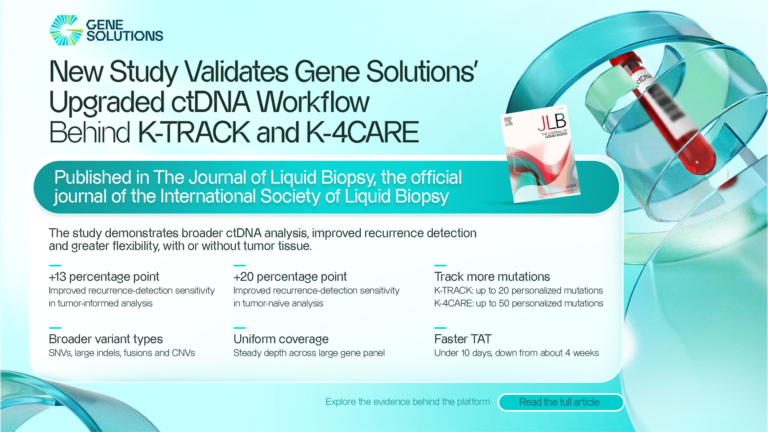
Real-world evidence shows high specificity and practical utility when tissue is unavailable, supporting relapse prediction, treatment surveillance and real-time resistance monitoring.

Gene Solutions today announced the publication of a new study in Therapeutic Advances in Medical Oncology (TAM) titled “Tumor-naïve multimodal profiling of circulating tumor DNA to detect minimal residual disease in solid tumors”. The study demonstrates the clinical performance of an AI-powered, multi-omics, tumor-naïve circulating tumor DNA (ctDNA) assay for detecting MRD (minimal residual disease) and predicting recurrence across solid tumors. This approach offers a reliable alternative when high-quality tissue samples are unavailable, a common challenge in Southeast Asia.
The retrospective study analyzed 948 cancer patients and 566 non-cancer donors, integrating mutation detection with non-mutation features (copy-number alterations – CNAs and fragmentomics) to improve sensitivity. Clinical validation included 97 breast cancer and 51 colorectal cancer patients, correlating tumor-naïve ctDNA status with observed recurrence outcomes.
Key findings:
- Higher ctDNA detection through multi-omics profiling: Combining mutation with non-mutation features (CNAs and fragmentomics) significantly increased ctDNA detection sensitivity by >10% in metastatic cancers.
- Dual workflow for enhance mutation detection: Amplicon sequencing with ultra-deep coverage (100.000x) enabled detection of low-VAF mutations, while hybridization sequencing broadened variant coverage, including gene fusions.
- Recurrence prediction outperforms several existing tumor-naïve assays: This assay achieved 80.0% sensitivity and 100% specificity in colorectal cancer (HR=35.6, p<0.0001) and 54.5% sensitivity and 98.8% specificity for recurrence prediction in breast cancer (HR=23.3, p<0.0001)
- Operational efficiency: By leveraging cfDNA libraries already prepared for mutation analysis to also assess non-mutation features, the workflow demonstrated a streamlined, cost-effective process amenable to routine practice.
- Alternative to tumor-informed methods: While overall accuracy was lower than personalized tumor-informed assays, the tumor-naïve approach proved valuable for high ctDNA-shedding cancers and metastatic stages.
The study also addressed the common challenge of clonal hematopoiesis (CHIP), particularly mutations in TP53, and implemented white blood cell sequencing to reduce false positives.
“Personalized, tumor-informed testing requires high-quality tissue, which is not always feasible in routine practice across Southeast Asia,” said Lan N. Tu, PhD, Principal Investigator at Gene Solutions. “Our data provide evidence that tumor-naïve ctDNA analysis as a practical way to monitor tumor dynamics and recurrence risk in real time when tissue is limited or unavailable.”
Publication full-text here: Tumor-naïve multimodal profiling of circulating tumor DNA to detect minimal residual disease in solid tumors
Study summary here: K-TRACK BO_Study Summary_TAM
Why This Matters
For oncologists managing patients in resource-limited settings or those with inaccessible tumor tissue, this publication provides evidence-based support for adopting tumor-naïve ctDNA assays. It also highlights the importance of integrating multimodal genomic features to enhance sensitivity and reliability in MRD detection.
Looking Forward
Gene Solutions plans to expand clinical validation of the assay in larger prospective trials and explore AI-enhanced models to further improve sensitivity, especially in early-stage and low ctDNA-shedding cancers.