A blood-based cancer screening technology developed in Asia is gaining international attention after real-world data from more than 84,145 individuals were presented at ASCO Breakthrough 2026 and highlighted by the American Society of Clinical Oncology. For Gene Solutions, this milestone underscores the growing global relevance of Asia-led multi-cancer detection innovation.
SINGAPORE, July 7, 2026 — Gene Solutions, announced a major global milestone for SPOT-MAS 10, its AI-powered, multi-omic blood-based test for multi-cancer screening.
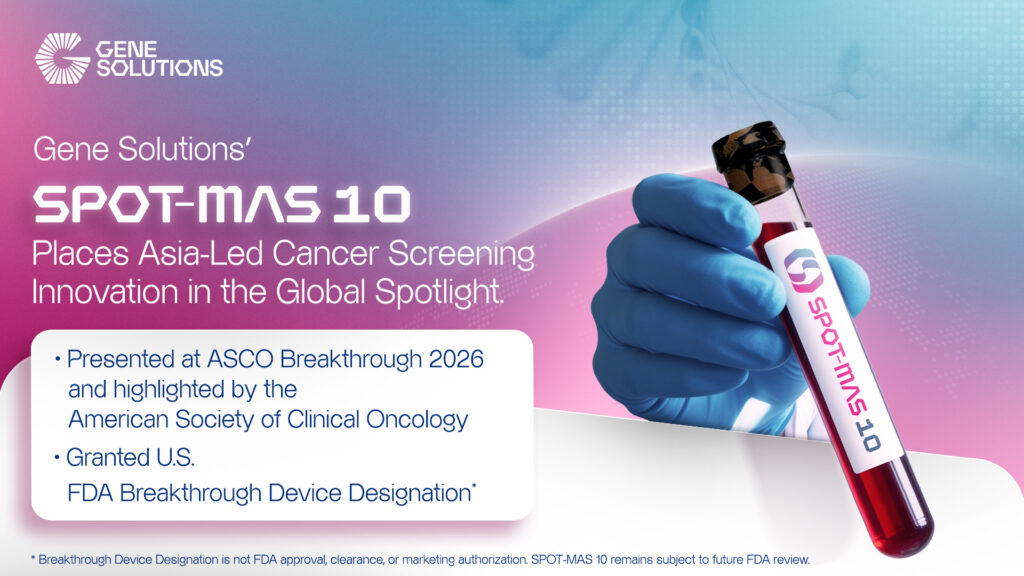
Following its presentation at ASCO Breakthrough 2026 in Singapore, SPOT-MAS 10 clinical data have gained international attention through several key milestones: the presentation of a large-scale real-world study involving more than 84,145 asymptomatic individuals, recognition by the American Society of Clinical Oncology (ASCO) Press Center, coverage in ASCO’s Science in Seconds, and the recent granting of U.S. FDA Breakthrough Device Designation.
The achievement reflects Gene Solutions’ expanding global footprint. Bloomberg recently reported that the company is preparing for a potential Hong Kong IPO to support international growth, signaling increasing investor confidence in Asia-originated genomic technologies.
Large-Scale Asian Real-World Evidence Presented at ASCO Breakthrough 2026
The study, titled “Real-world performance of a multimodal cell-free DNA multi-cancer early detection test in Asian populations,” evaluated SPOT-MAS in 84,145 asymptomatic individuals across Singapore, Thailand, Indonesia, the Philippines, Malaysia, and Vietnam. ASCO’s Press Center highlighted the study ahead of ASCO Breakthrough 2026, noting the importance of evaluating multi-cancer early detection in routine clinical settings in Asia.
In an interim analysis of 22,597 individuals with at least 12 months of follow-up, SPOT-MAS demonstrated performance consistent with earlier prospective validation study (K-DETEK). Notably, the test effectively identified cancers that typically lack routine screening programs in the region, including stomach, liver, and nasopharyngeal cancers.
ASCO Expert Commentary
ASCO Expert Julian Hong, MD, MS, radiation oncologist at University of California, San Francisco (UCSF) discussed the study in ASCO’s Science in Seconds segment. He highlighted the potential of SPOT-MAS in multi-cancer early detection while emphasizing the importance of continued research, responsible interpretation, and appropriate diagnostic follow-up.
The SPOT-MAS study was led by Dr. Dang Luu Hong Nguyen of the Medical Genetics Institute. Dr. Dang also received a Conquer Cancer Merit Award at ASCO Breakthrough 2026, recognizing the quality and scientific merit of the research submitted to an ASCO meeting.
“Asia has a fundamentally different cancer landscape from the populations in which other MCED tests have been validated. Liver, gastric, and nasopharyngeal cancers are highly prevalent in this region yet have no standard screening programs. To date, this is the largest real-world MCED cohort reported from any Asian population,” said Dr. Dang Nguyen, following ASCO’s media interview.
Why Asia-Led Evidence Matters
“Multi-cancer early detection is an area where evidence generation must reflect the populations and healthcare systems in which the technology will be used,” said Prof. Herbert Ho Fung Loong of The Chinese University of Hong Kong. “Large-scale real-world data from Asian populations are particularly important given the distinct cancer epidemiology across the region. The ASCO press release highlighted that SPOT-MAS data contribute meaningfully to this evolving evidence base and demonstrate how Asia-originated innovation can be evaluated in a globally relevant context. The U.S. FDA Breakthrough Device Designation is also an important milestone for emerging technologies like SPOT-MAS 10. While it is not regulatory approval in the United States, it reflects the need for continued rigorous evaluation of Asia-based technologies that may address major unmet needs in cancer detection.”
SPOT-MAS 10 is designed to detect cancer-associated signals from circulating cell-free DNA using a multi-omic approach that includes methylation and fragmentomic signatures supported by machine-learning analysis. The test is intended as a complementary screening approach and does not replace existing guideline-recommended cancer screening programs.
In May 2026, Gene Solutions announced that the U.S. Food and Drug Administration granted Breakthrough Device Designation to SPOT-MAS 10. The proposed intended use describes SPOT-MAS 10 as an adjunctive screening test for asymptomatic adults aged 40 years and older, designed to assist in detecting cancer-associated signals across cancer types within the scope of the assay.
Breakthrough Device Designation is not FDA approval, clearance, or marketing authorization, and SPOT-MAS 10 remains subject to applicable FDA review requirements.
About SPOT-MAS 10
SPOT-MAS 10 is an AI-powered, multi-omic blood-based test developed by Gene Solutions to detect cancer-associated signals from circulating cell-free DNA. The test integrates methylation and fragmentomic signatures using machine-learning-based analysis and is designed to support multi-cancer early detection across 10 cancer types. SPOT-MAS 10 is intended to complement, not replace, existing guideline-recommended screening programs. Positive results require physician-directed diagnostic follow-up.
Contact: [email protected]