Preterm birth (PTB), defined as delivery before 37 completed weeks of gestation, remains one of the most consequential and difficult-to-predict complications in obstetric care. It affects roughly 11% of live births globally and is the leading cause of mortality in children under five years of age. Despite this impact, clinicians still struggle to identify many at-risk pregnancies until late in gestation, when opportunities for prevention are limited.
Current screening tools such as cervical length measurements, fetal fibronectin testing, and PAMG-1 testing are typically performed later in pregnancy and have only modest predictive value. Most spontaneous preterm births occur in women with no obvious risk factors. For clinicians, the central challenge is not simply recognizing preterm labor once it has begun. It is identifying risk early enough to support closer surveillance, further diagnostic assessment, and potentially preventive care.
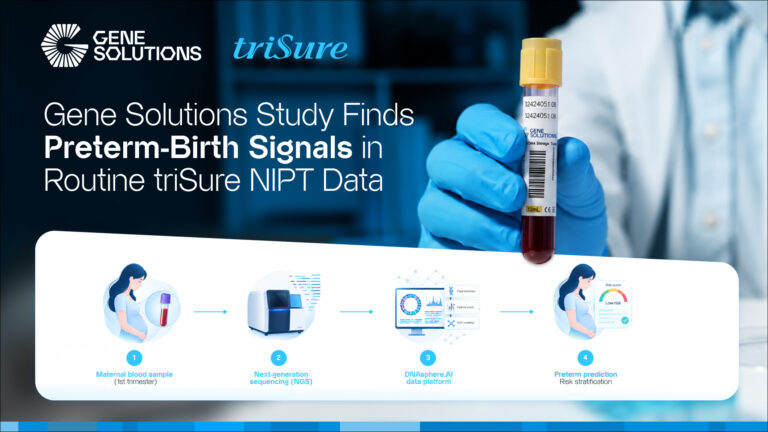
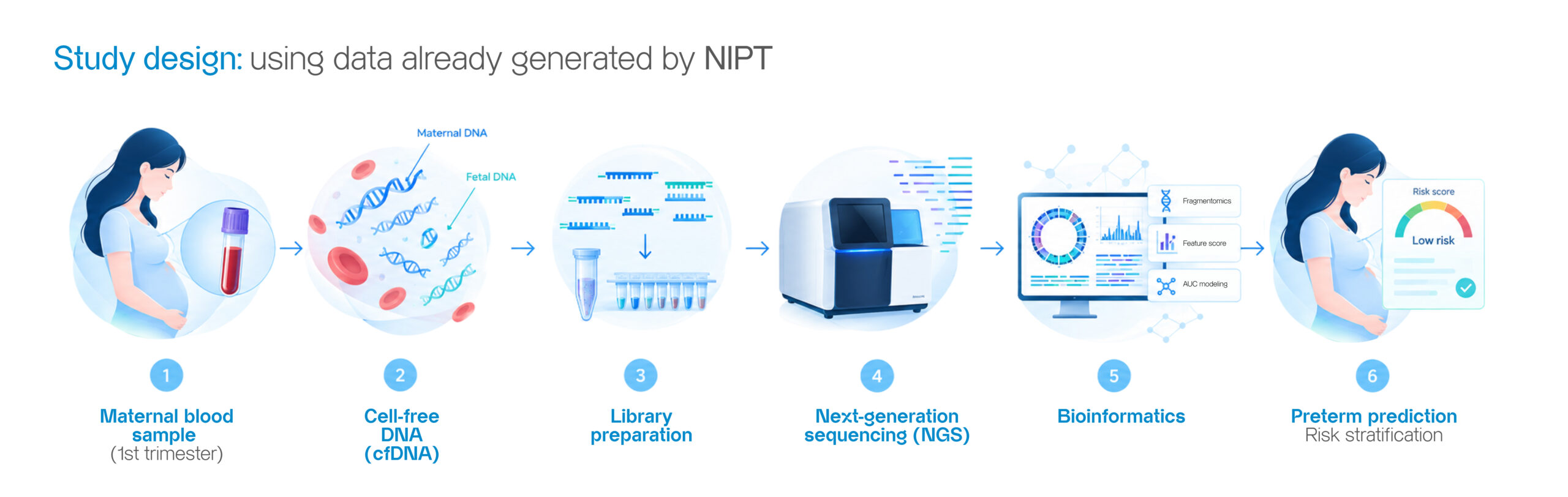
In our new study, “First-Trimester Non-Invasive Prediction of Preterm Birth Using Cell-Free DNA Fragmentomics,” published in AJOG Global Reports, we investigated whether the cell-free DNA already generated during routine first-trimester non-invasive prenatal testing, or NIPT, could provide an early molecular signal of spontaneous preterm birth.
The Fragmentome: A Molecular Window Into The Placenta
Current NIPT primarily examines the sequence and copy number of cell-free DNA (cfDNA) to screen for fetal aneuploidies. However, cfDNA—which is released into the mother’s bloodstream through the programmed cell death of placental trophoblasts and maternal cells—is more than just a genetic code. It acts as a dynamic, real-time molecular window into the interplay between the placenta, fetus, and mother.
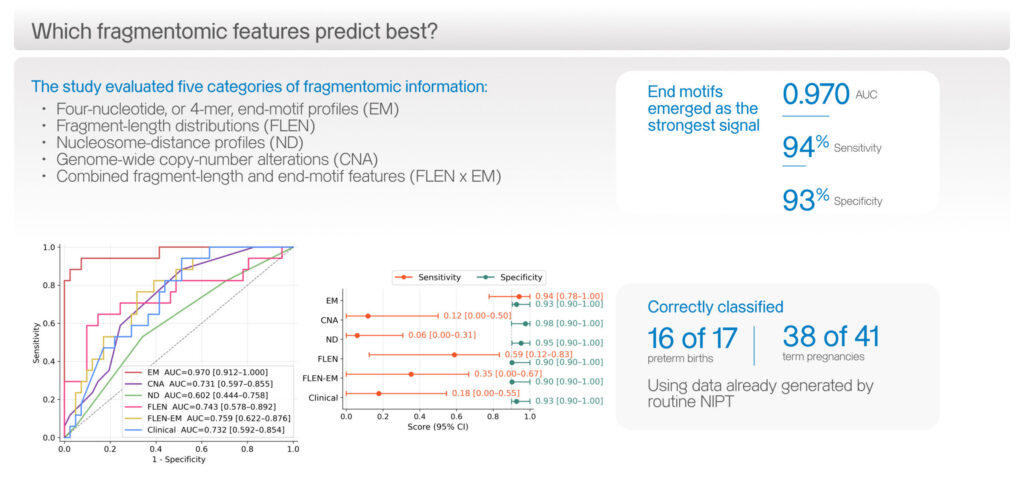
Fragmentomics expresses the physical characteristics of the cfDNA fragments themselves, such as their length, where they were cut, and how they wrapped around nucleosomes. In our multi-center cohort study of 286 pregnancies, we evaluated five distinct fragmentomic feature categories:
- Copy number alterations (CNA)
- Nucleosome distance (ND)
- Fragment length (FLEN)
- End-motif (EM) composition
- Joint fragment-length and end-motif (FLEN x EM)
End motifs provided the clearest signal
Among all the features evaluated, the 4-mer end-motif (EM) profiles exhibited the most pronounced differences between PTB and term control samples.
The underlying biology explains why this marker is so powerful. Cell-free DNA is not cut at random. Extracellular endonucleases, such as DNASE1L3, act as “molecular scissors” that cut cfDNA at preferred sites, leaving behind a specific 4-nucleotide EM signature. Spontaneous preterm labor is a syndrome driven by converging pathways, including intra-amniotic inflammation, decidual senescence, and trophoblast apoptosis. These pathological processes shift the balance of circulating nucleases and alter chromatin states, changing exactly where the cfDNA breaks.
Because EM frequencies shift coherently across the entire fragmentome, they provide a dense, system-wide readout of cleavage chemistry that directly tracks the systemic inflammatory mechanisms of PTB. This makes EM a highly robust signal, even at the shallow sequencing depths (~20 million reads) utilized in standard NIPT.
We used end-motif frequencies to develop an L1-regularized (LASSO) logistic regression classifier. This approach selected 59 informative motifs from the 256 candidates while reducing the contribution of the remaining motifs to zero.
In five-fold cross-validation within the training cohort, the end-motif classifier achieved a median area under the receiver operating characteristic curve, or AUC, of 0.980.
Performance remained consistent in the held-out internal validation cohort:
- AUC: 0.970
- Sensitivity: 94%
- Specificity: 93%
At the prespecified high-specificity operating point, the model correctly classified 16 of 17 spontaneous preterm births and 38 of 41 term births.
DNAsphere.AI, our precision data and AI platform, enabled this analysis by integrating large-scale, well-annotated datasets with multi-omic analysis and machine learning. Combining routine NIPT data with these capabilities allowed us to examine biological signals beyond DNA sequence and explore how cfDNA fragments are formed.
A New Layer of Insights from Routine NIPT
For clinical integration, this approach offers a pragmatic, scalable path forward. By analyzing the exact same plasma and sequencing data already collected for routine NIPT screening, our prediction model requires no additional blood draws for the patient and no extra wet-lab sequencing costs for the clinic.
Our findings present strong proof-of-concept evidence that we can transform the established NIPT infrastructure into a comprehensive, multi-omic early-warning system. Looking ahead, we are actively exploring how these cfDNA fragmentation fingerprints might also identify early metabolic disruptions, such as those seen in gestational diabetes mellitus (GDM).
While prospective validation in multi-ancestry cohorts is the next crucial step, these findings move us closer to a future in which a single first-trimester blood draw could give HCPs predictive insights to help monitor and manage high-risk pregnancies proactively.
A Global Shift in Prenatal cfDNA Research
These findings form part of an international shift in prenatal cfDNA research. In August 2026, an independent study published in AJOG Global Reports evaluated multimodal first-trimester cfDNA analysis for predicting preterm and term preeclampsia. During the same month, a separate study published in Science Translational Medicine analyzed 1,910 first-trimester cfDNA samples and found that fragment-length, end-motif and cell-of-origin signals could help stratify adverse pregnancy-outcome in patients with immune-mediated disease. Although these studies examined different complications, populations and analytical approaches, their findings point toward a common scientific direction: cfDNA may provide insight into pregnancy biology beyond fetal chromosomal status.
Study summary here: Click here
Publication full-text here: Click here