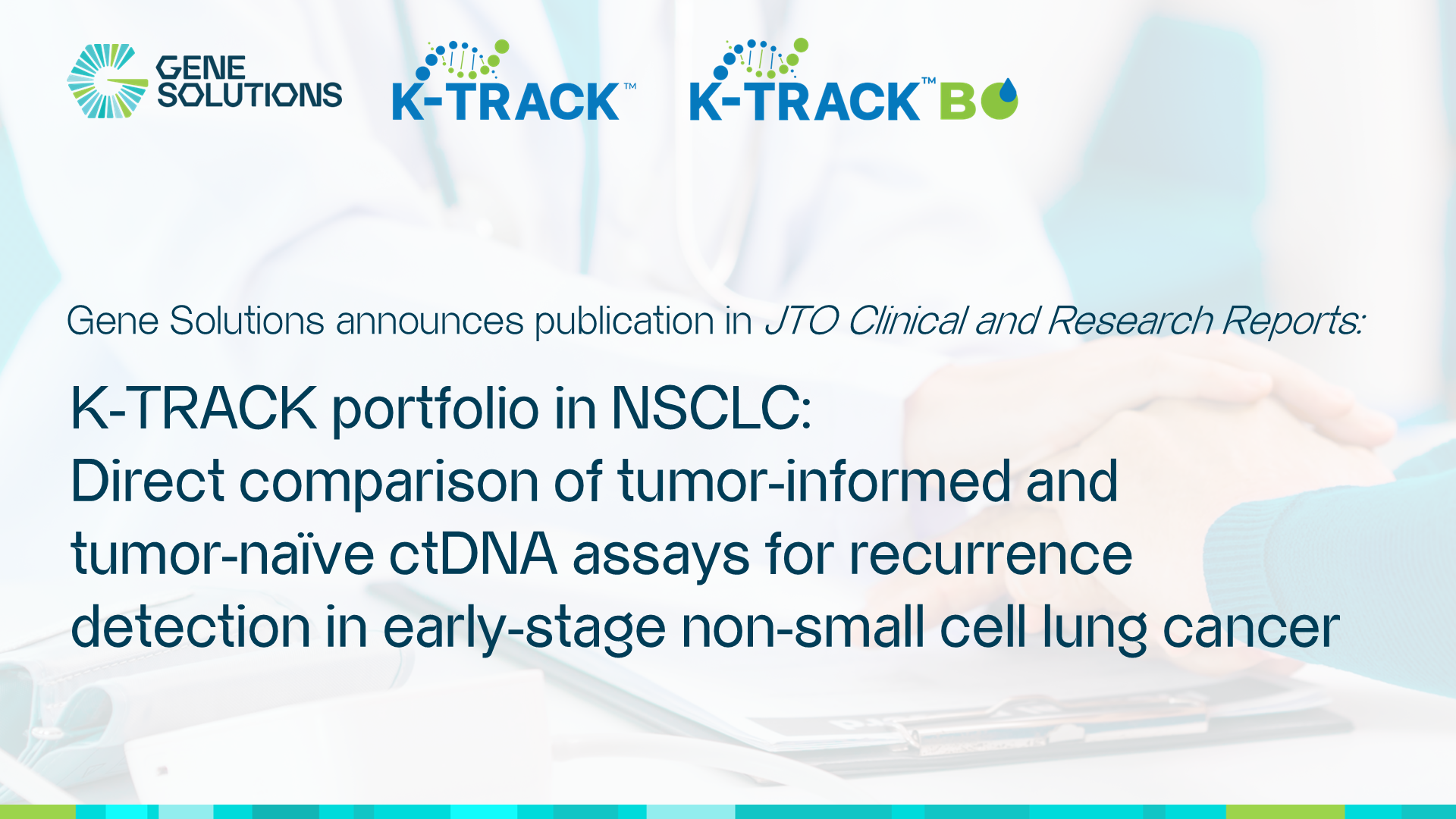
Gene Solutions is pleased to announce the publication of our latest research in JTO Clinical and Research Reports, evaluating the K-TRACK portfolio entitled: “Direct Comparison of Tumor-Informed and Tumor-Naïve ctDNA Assays for Recurrence Detection in Early-Stage Non-Small Cell Lung Cancer.”
This first-of-its-kind study delivers a direct, real-world comparison of two ctDNA-based minimal residual disease (MRD) assay – tumor-informed (K-TRACK) and tumor-naïve (K-TRACK BO – blood-only). By using the same patient samples and the same sequencing platform, the study offers an unbiased evaluation of 168 individuals, including 118 patients with early-stage non-small cell lung cancer (NSCLC) and 50 healthy donors.
Overcoming Clinical Barriers in MRD Detection
MRD detection through circulating tumor DNA (ctDNA) is transforming cancer surveillance. For early-stage NSCLC patients, recurrence risk remains significant even after surgery. Detecting MRD early can open a critical window for intervention. However, tumor-informed assays (K-TRACK) require high-quality tissue – a common challenge when biopsy or surgical samples are limited or degraded.
Tumor-naïve ctDNA assays (K-TRACK BO – blood-only) eliminate this barrier, offering a faster, tissue-independent alternative. The central question is: When tissue samples are limited, can blood-only tests deliver reliable results? Our study answers this with robust evidence.
What was compared: K-TRACK vs K-TRACK BO
| K-TRACK (Tumor-informed assay) | K-TRACK BO (Tumor-naïve assay) | |
| Approach | Tumor tissue (FFPE) + matched WBC to identify patient-specific somatic mutations across 155 cancer-associated genes.
Tracks 5–8 top personalized mutations plus a fixed 500-hotspot lung cancer panel in plasma at ultra-deep coverage (100,000×). |
No tumor tissue needed. Uses plasma cfDNA for:
|
| Recurrence Detection (Clinical performance) | ||
| Sensitivity | 86.7% | 80.0% |
| Specificity | 98.4% | 98.4% |
| PPV | 92.9% | 92.3% |
| NPV | 96.8% | 95.2% |
Key results
- Both approaches strongly predict recurrence: Post-operative ctDNA positivity was associated with markedly worse 24-month disease-free survival (DFS), with hazard ratios >100 (p < 0.0001).
- Innovations that improved clinical performance
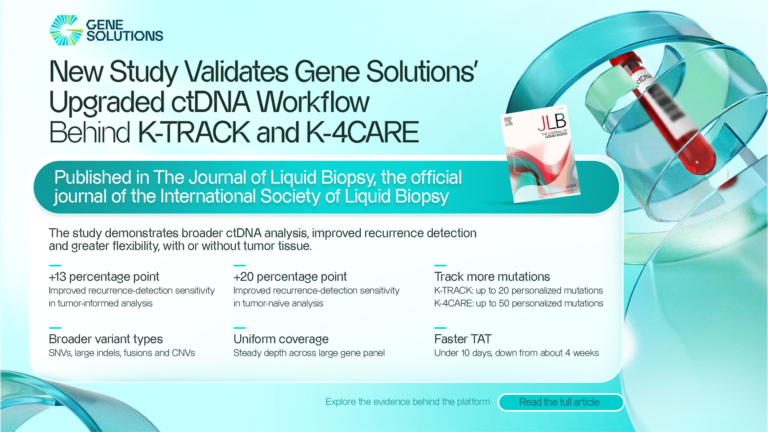
- In tumor-informed assay, adding the 500-hotspot panel improved sensitivity by 13.4% without affecting specificity (supporting real-world use when FFPE quality is suboptimal).
- In blood-only testing, adding non-mutation genome-wide features improved sensitivity by 20.0%, highlighting the importance of multi-omics integration in blood-only ctDNA-MRD assay.
- ctDNA positivity preceded clinical recurrence by up to 14.4 months (median lead time: ~2–3 months), opening a window for earlier intervention or intensified follow-up.
- Actionable molecular insights during monitoring: The fixed hotspot panel revealed resistance mutations at relapse. Common early plasma mutations included TP53 (61.5%), EGFR (38.5%), and KRAS (15.4%), with frequent TP53+EGFR co-mutations.
Study summary here: Click here
Publication full-text here: Click here
How this translates into real-world clinical practice?
This publication reinforces two complementary clinical use cases:
- Post-operative risk stratification: ctDNA can help identify patients with residual disease who may benefit from intensified follow-up and more proactive management strategies.
- Longitudinal monitoring: Multi-omic serial ctDNA testing can detect recurrence ahead of conventional tools and may provide a clinically meaningful lead time for earlier intervention planning.
- Hotspot mutations panel help reveal resistance mutations during monitoring.
Choosing the right approach
| K-TRACK (Tumor-informed assay) | K-TRACK BO (Tumor-naïve assay) |
|
|
Together, the K-TRACK portfolio offers a flexible, real-world ctDNA-MRD solution for diverse clinical settings.
Looking Forward
This study marks a pivotal step toward personalized, non‑invasive cancer monitoring, but it is only the beginning. Our next efforts will focus on enhancing blood‑only (tumor‑naïve) MRD performance by expanding genome‑wide, non‑mutation signals and strengthening machine‑learning integration. The goal is to deliver more sensitive and actionable recurrence‑risk stratification in routine clinical follow‑up.
We will also initiate prospective, multi‑center studies with larger cohorts to validate performance across diverse populations, disease stages, and treatment pathways.