The Gene Solutions research team, in collaboration with Ho Chi Minh City Oncology Hospital and several oncology centers, has published new peer-reviewed data in BMC Biology demonstrating that a multimodal analysis of plasma cell-free DNA (cfDNA) can accurately differentiate early-stage breast cancer from benign breast conditions (e.g., fibroadenoma)—a frequent real-world challenge that often leads to unnecessary biopsies. The study integrates genome-wide fragmentomics and copy number signals with targeted methylation features in a single low-depth sequencing workflow.¹

What the new paper shows (at a glance)
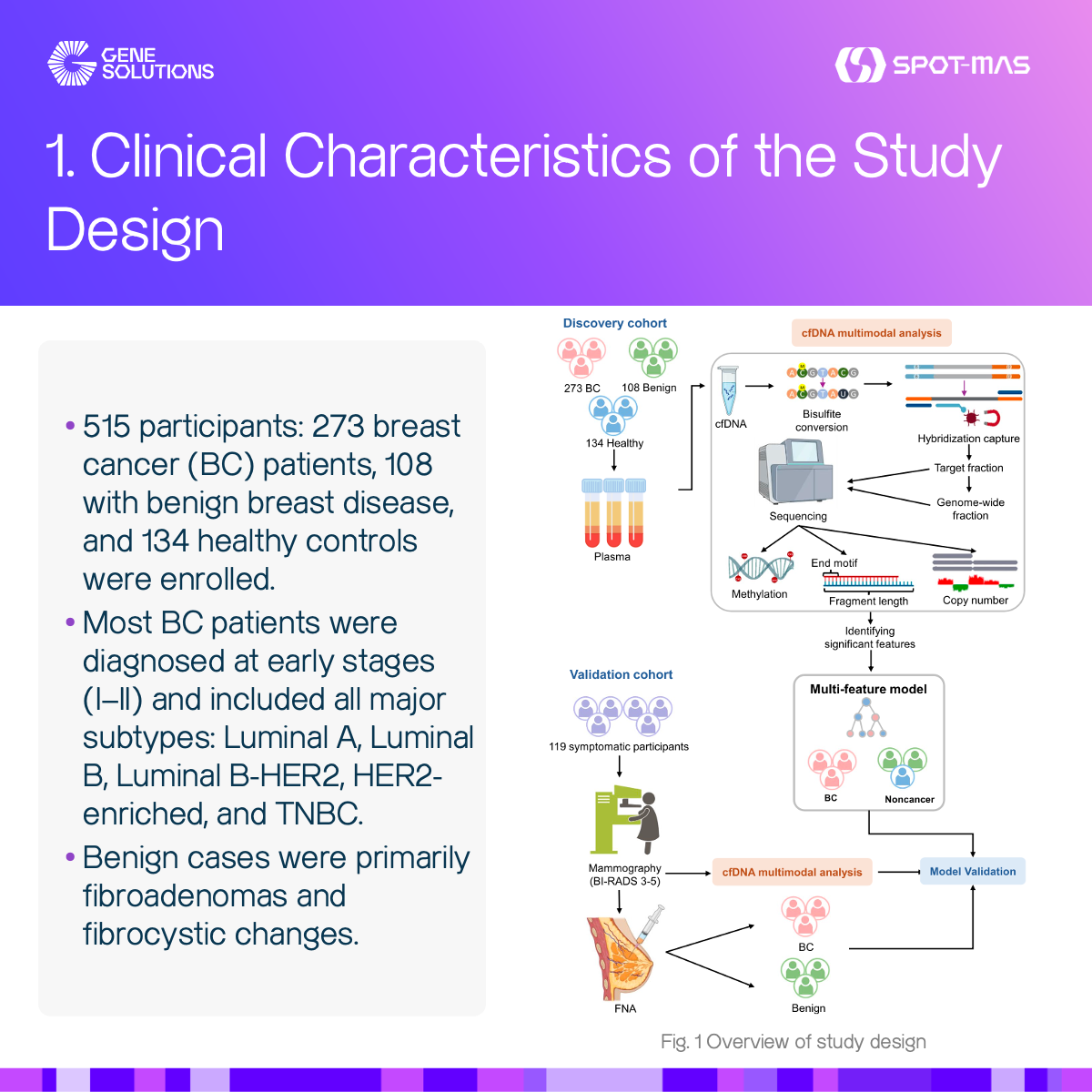
- Study design: 515 participants in a discovery cohort (273 breast cancer, 108 benign lesions, 134 healthy controls) and 119 symptomatic participants (BI-RADS 3–5) in an independent validation cohort; one 10mL blood draw per participant. The assay profiled five cfDNA feature families: copy number aberrations (CNA), 4mer end motifs (EM), 21mer cleavage site motifs (ME21), targeted methylation density (TMD) across 450 regions, and targeted CNA (T_CNA).1
- Performance (test set; cancer vs noncancer): AUC ~0.90 with overall sensitivity 66.2% at high specificity (≥91–96%); stage stratified sensitivity was 62.1% (stage I) and 66.3% (stage II) under a ≥95% specificity operating point.1
- Real-world diagnostic setting (validation cohort; BI-RADS 3–5): Sensitivity 65.1% and specificity 96.1% for distinguishing malignant from benign lesions; specificity reached 100% in BI-RADS 5 and 93.3–96.6% in BI-RADS 3–4.1
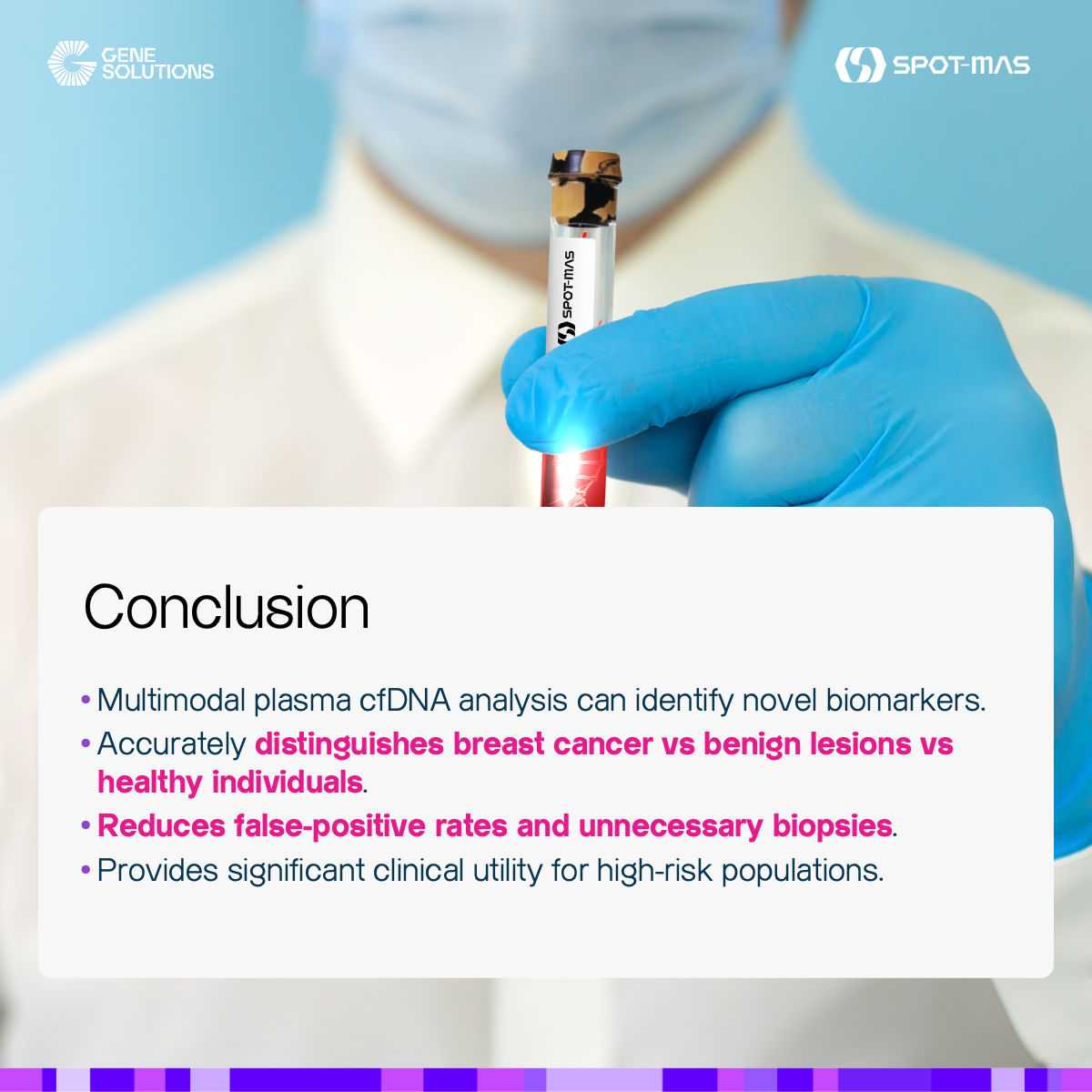
- Why this matters: Accurately separating benign from malignant lesions can lower false positives and reduce unnecessary biopsies—an ongoing challenge in breast imaging clinics, particularly for younger women and those with dense breast tissue.1
How this compares with current SPOT‑MAS (MCED) information
SPOT-MAS is Gene Solutions’ AI-powered cfDNA platform for multi-cancer early detection (MCED) and tumor-of-origin (TOO) localization using multi-omics features (genetics, epigenetics, fragmentomics) analysis in one workflow.
- eLife 2023 MCED publication across five cancers (breast, colorectal, gastric, lung, liver): In the case–control MCED setting, breast cancer sensitivity was ~49.3%, reflecting the known challenge of low ctDNA shedding in early breast cancer.2
- BMC Medicine 2025:A prospective validation study of 9,024 participants established SPOT-MAS as the first clinically validated MCED test in Asia, confirming its clinical performance for multi-cancer detection and tumor-of-origin prediction.3
- New BMC Biology (2025): A breast specific model, trained to explicitly separate cancer from benign lesions, improved detection to ~62–66% for stage I–II at high specificity and maintained 96.1% specificity in symptomatic BI-RADS 3–5 cohorts—while continuing to use the same low depth, single workflow concept.1
Takeaway: The breast-focused model described in BMC Biology enhances SPOT-MAS performance for breast cancer, particularly in diagnostic contexts where benign lesions are common – complementing the multicancer breadth of the existing SPOT-MAS MCED approach.
Where SPOT‑MAS stands today
- First clinically validated MCED test in Asia (BMC Medicine 2025), based on a prospective study of 9,024 participants.3
- Available at hospitals and clinics across Asia (including Singapore, Hong Kong, Taiwan, India and Southeast Asia): SPOT-MAS offers multicancer early detection and TOO localization for 5–10 common and aggressive cancers (availability may vary by country), using next-generation sequencing plus AI on ctDNA signals.
- Ongoing prospective validation: The K-ACCELERATE multicenter study (NCT06391749) is enrolling ~1,000 symptomatic participants across five major cancers to evaluate diagnostic performance and triage utility in real-world pathways.4
Why this matters for patients and clinicians
- Fewer false positives / biopsies: High specificity against benign lesions suggests value as a complementary diagnostic tool alongside imaging—especially in dense breasts where BI‑RADS 3–4 lesions are common.1
- Earlier detection in a hard to detect cancer: Boosting early-stage breast sensitivity (while keeping specificity high) tackles the biological low ctDNA barrier that has limited breast performance in many MCED assays.1
Looking ahead
Gene Solutions is expanding prospective clinical validation of SPOT-MAS in high-risk diagnostic pathways through K-ACCELERATE (NCT06391749) and continues to optimize multi-omics feature engineering and AI models for broader clinical utility across cancers.
References:
(1) Van TTV et al. BMC Biology (2025).
(2) Nguyen VTC et al. eLife (2023).
(3) Nguyen L.H.D et al. BMC Medicine (2025).
(4) ClinicalTrials.gov Identifier: NCT06391749.